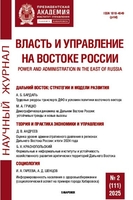
CONTENTS
№ 3 (116) 2026
1Chekunkov A. O.
Kuznetsov M. Ye.
Development Strategy of the Far-Eastern Federal district 2026–2036: new stage of advanced development
Abstract. The article substantiates the logic of a new stage of advanced development of the Far East, enshrined in the Strategy for socioeconomic development of the Far-Eastern Federal district until 2030 with a forecast until 2036: if the content of the first stage (2013–2025) was the creation of basic conditions, the removal of infrastructure barriers and the macro-region's achievement of outstripping the average Russian growth rates of investments and gross regional product, then the content of new stage (2026–2036) is a new quality of growth - a shift to deep processing, technology and productivity, in which the Far East forms sources of growth on a national scale. Based on statistical data, the results of first stage (2013–2025) are characterized. Comparison of the economic structure and export potential of the macro-region with the import structure of the countries of East and Southeast Asia, primarily China is made; The article highlights the segments in which the Far East has a cost-based competitive advantage, as well as the key constraint to competitiveness–the labor productivity gap. It also explores prerequisites and parameters for the accelerated development forecast to 2036, including the sectoral structure of gross value added growth. The article draws on scientific foundations of the Far-Eastern school of economics and international concepts of accelerated and export-oriented growth, capturing the advancement of knowledge: empirical analysis of completion of the first-stage objectives and a quantitative assessment of e conditions for transition to a new quality of growth.
Keywords: the Far East, strategic planning, accelerated development, investment and technology cycle, the Asia-Pacific region, China, competitiveness, labor productivity, export potential, forecasting
2Kharitonov N. M.
On legislative support for strategic development of the Far East
Abstract. The article considers legislative aspects of ensuring the advanced socio-economic development of the Far East as a key tool for implementation of the strategic initiatives and the results of their application. Analysis of changes in the economic situation of the Far-Eastern Federal district are presented, the main problems of improving the legal support for investment processes in the region are presented. The main mechanisms for the formation of a favorable regime for the development and strategic development of the Far East are considered. An important place is given to the adaptation of regional policy to the modern realities of development, coordination of local and national tasks, ensuring harmonious interaction of territorial decisions and macroeconomic balance. Particular attention is paid to the legislative support for the functioning of preferential regimes in the Far-Eastern Federal district. Development and use of special preferential projects for the Far East has become an important part of modern development programs for the Far-Eastern. The article shows the importance of forming a single preferential regime in the Far East and the Arctic. Special place is paid to the issues of legislative regulation of the northern delivery as an important element of ensuring the functioning of territories with the complex development conditions and formation of their targeted regional support. Based on the monitoring and analysis of the law enforcement practice, promising directions for the development of legislation aimed at ensuring the implementation of the Strategy for the socio-economic development of the Far-Eastern Federal district until 2030 with a forecast until 2036, prepared in accordance with the instructions of the President of the Russian Federation V.V. Putin following the results of the 10th Eastern Economic Forum.
Keywords: legislative framework, preferential regimes, effectiveness of legal mechanisms, northern delivery
3Andreev D. V.
Factors and characteristics of investment behavior of residents of preferential regimes in the Far-Eastern Federal district
Abstract. By instruction of the Deputy Chairman of the Government of the Russian Federation – Plenipotentiary Representative of the President of the Russian Federation in the Far-Eastern Federal district, Y.P. Trutnev, the Investment Ombudsman for the Far-Eastern Federal district has systematically established work to obtain feedback from the representatives of small and medium-sized enterprises operating under the standard tax regime, business associations, and residents of preferential regimes. It is aimed at understanding the current problems and «bottlenecks» that constrain implementation of the investment intentions of entrepreneurs in the Russian Far East, with the goal of developing management decisions to address them. The channels for obtaining such feedback include not only participation in different roundtables, conferences and business meetings, but also conducting the regular surveys of entrepreneurs. The article presents results of the questionnaire-based survey conducted in March–April 2026 among more than 775 residents of the advanced special economic zones (territories of advanced development) and the Free Port of Vladivostok, who are implementing their projects in the Far-Eastern Federal district. The main objective of this survey was to assess the level of administrative pressure on the residents of preferential regimes in the federal district and its impact on their investment and business activities, as well as to evaluate the sufficiency of the government support measures, including benefits and preferences available to the residents of preferential regimes for launching their investment projects. The survey of residents made it possible to conclude that there is a high level of demand among the entrepreneurs for support and investor protection mechanisms within the framework of preferential regimes. At the same time, it also revealed the need for further improvement of deregulation mechanisms. The article identifies directions for enhancing the effectiveness of preferential regimes from the perspective of eliminating constraints that hinder the residents of these special economic regimes from realizing their investment intentions.
Keywords: the Far East, advanced development, preferential regimes, business support, deregulation of business activities, feedback from business
4Altabaev V. V.
Decade of preferential policy in the Far East and the logic of institutional consolidation
Abstract. This article summarizes the results of a decade of preferential regimes in the Far East (2015–2025) – the largest experiment in the territorially oriented economic policy in the post-Soviet Russia – and substantiates the rationale for transition to a unified preferential regime, developed in pursuance of instructions of the President of the Russian Federation following the 10th Eastern Economic Forum. Drawing on international literature on special economic zones and place-based policy, the article formulates performance criteria for zonal instruments and analyzes the accumulated results: over 3,700 residents, 1,282 established enterprises, and approximately 11 trillion rubles in investment under binding agreements, with investment growth rates in the Far East significantly exceeding the Russian average. A separate section is devoted to criticism of preferential policy in scientific literature and recognized problems of the current model: fragmentation of the legal framework, heterogeneity of the resident base, and methodological difficulties in causal impact assessment. It is shown that identified problems are institutional, not conceptual, and that the answer to them lies in consolidation of instruments. Principles of unified preferential regime are discussed – unified legal framework, continuity of rights for existing residents, prioritization of industries, and the client-centric digital administration–as well as the risks of the transition period and a proposed system of indicators for assessing the new regime.
Keywords: preferential regimes, advanced development areas, free port of Vladivostok, the Arctic zone, special economic zones, unified preferential regime, investments, place-based policy, the Far East, institutional consolidation
5Nurgalieva E. R.
Territory for living: Master Plans, social infrastructure and demographic turnaround of the Far East
Abstract. This article argues that, given the depletion of labor supply in the Far East, social and spatial policy is acquiring the status of economic strategy: demographic set of target indicators forms the semantic boundary between the inertial and target scenarios of the Strategy for socioeconomic development of the Far-Eastern Federal district until 2030 with a forecast to 2036. Statistical material characterizes the demographic turnaround that has taken place – the transition from an average annual migration loss of over 30,000 people in the 2010s to a migration gain of 24,200 people in 2024 with a birth rate 13% higher than the Russian average – and its incompleteness. Drawing on the theory of push and pull factors of migration and the concept of «quality of place,» the three-loop architecture of population-preservation policy is revealed: master plans for 25 cities as the core of spatial-social policy (the estimated effects are a 7% increase in the population of agglomerations and a 45% increase in the internal urban product); advanced standards of social infrastructure and services in healthcare, education, and the creative economy; and the Far-Eastern demographic package. A system for managing implementation based on a digital information system is presented (1,200 objects, 57 checkpoints for each). The target trajectory – population stabilization at 7.9 million with an accumulated net migration increase of 181,000 by 2036 – is interpreted as a necessary condition for achieving the economic goals of accelerated development.
Keywords: population conservation, demography, migration, city master plans, urban quality, social infrastructure, human capital, the Far East, core communities, strategic planning
6Basanskiy A. A.
Kuznetsov M. Ye.
Novitskiy A. A.
From unique nature to hospitality industry: Tourism as a new specialization of the Russian Far East
Abstract. The article substantiates emergence of tourism as a new economic specialization of the Far-Eastern Federal district (FEFD) and outlines specific provisions of the draft Tourism Development Strategy in FEFD through 2036, developed to advance the Strategy for socio-economic development of the Far-Eastern Federal district through 2030 with a forecast until 2036. It highlights a key paradox of the sector: consistently outstripping demand growth coincides with one of the lowest occupancy rates of collective accommodation facilities among all federal districts (24%), indicating a structural mismatch between supply (in terms of geography, quality, and seasonality) and actual demand. The article examines the prospects, constraints, key drivers, and priority directions for the development of the tourism industry in the FEFD. Finally, it presents an industry forecast through 2036, projecting an increase in annual tourist trips in the FEFD to 9.6 million, a fivefold growth in inbound traffic, and creation of over 70,000 new jobs.
Keywords: tourism, the Russian Far East, strategic planning, tourism infrastructure, economic diversification
7Tsidenov А. S.
Socio-economic development of the Republic of Buryatia: Modernization effects of 2021–2025 and strategic goals for the upcoming period up to 2030
Abstract. The article presents comprehensive analysis of the results of moderni-zation of transport, utility and social infrastructure of the Republic of Buryatia during the five-year period 2021–2025. This study is based on data on the implementation of national projects, federal target programs and macro-regional initiatives, including the Far-Eastern Subsidy, master plans for the cities of Ulan-Ude and Severobaykalsk, as well as the mechanisms of advanced development territories (ADT), infrastructure and treasury loans, and the Far-Eastern concession. The purpose of the work is to assess effectiveness of the use of special state support instruments available to the regions of the Far-Eastern Federal district in the context of subsidized budget and a high degree of spatial differentiation. Special attention is paid to the analysis of impact of preferential regimes on the dynamics of gross regional product, investment activity and quality of life of the population. It is revealed that Buryatia's integration into the system of preferences of the Far-Eastern Federal district has become a key driver of economic growth. During the period under review, the gross regional product more than doubled in nominal terms – from 302.8 billion rubles in 2020 to 623 billion rubles in 2025. A new terminal at Baikal Airport has been commissioned, sections of the Baikal-Amur Mainline have been reconstructed, and infrastructure for the Ozerny mining and processing plant has been built, among other projects. In the social sphere, the queue for kindergartens and the problem of the third shift at schools have been eliminated. Scientific novelty lies in proving the synergistic effect of simultaneous use of several federal support instruments – preferential regimes, infrastructure loans and concession mechanisms – which made it possible to ensure a multiplier effect for the regional economy. Results of the study can be used in the development of master plans for the other supporting territories of Siberia and the Far East, as well as in improving the mechanisms of state support for the macro-regions.
Keywords: Republic of Buryatia, national projects, infrastructure development, public transport, housing and utilities modernization, master planning, social policy
8Nikolaev A. S.
Yakutia – the territory of meanings: formation of a balanced economic model in a new planning stage
Abstract. The article is devoted to perspective areas of socio-economic development of the Republic of Sakha (Yakutia) in the context of starting of the Strategy for socio-economic development of the Far-Eastern Federal district until 2030 with a forecast until 2036, according to which the key task is to form a balanced economic model by the creation of new growth points through the high-tech, with a course towards innovation, and a diversified economic system, while maintaining the raw material advantage of the republic. It has been shown that resource availability, which is an advantage, correlates with structural vulnerability, and structural transformation requires the removal of infrastructure restrictions. Priority areas have been identified through which the structural transformation is being implemented: formation of the Northern latitudinal transport belt of the Russian Federation (sea and land) on the territory of the republic, modernization of energy infrastructure (creation of new generating capacities), investment projects, development of the non-resource sector, for example, creative industries (software development; cinema, design, folk arts, etc.), effective personnel policy, socially oriented projects. Diversification of the economy through the development of the non-resource sector will strengthen the sustainability of long-term development, leveling the risks of commodity sector, and integration of the republic's priorities into the national agenda contributes to strengthening the Russia's economic and technological sovereignty in the Asia-Pacific region and the Arctic. Directions for the development of human capital of the republic as the main strategic resource for development have been determined.
Keywords: Republic of Sakha (Yakutia), strategic planning, economic diversification, transportation corridors, Northern Sea Route, creative economy, data centers, permafrost, climate research
9Osipov А. M.
Zabaykalsk territory as an industrial heart and logistics center of the Far East: from extensive growth to a deep processing model
Abstract. Inclusion of the region into the Far-Eastern Federal district in 2018 and its subsequent development to date have led to a shift in its specialization: from the export-oriented raw material model to performing the system forming transport logistics and industrial functions on a national scale. Empirical basis of the study comprises statistical data for 2018–2025, the draft Strategy for socio economic development of the Far-Eastern Federal district up to 2030 with a forecast to 2036, as well as assessments of the global commodity market conditions. The analysis reveals exhaustion of the potential for extensive growth. Further development of the region is possible only through a transition to a model of deep processing of mineral raw materials, which involves removing three systemic constraints – the shortage of generating capacity, the skills imbalance, and the throughput capacity of cross border transport infrastructure – while creating conditions for generating the added value within the region. The author substantiates that the resource potential (including the country's largest copper deposit), advantageous border geographical position, and institutional preferences (the regimes of territories of advanced development) make it possible to ensure a threefold increase in the gross regional product by 2036 and to establish on the basis of the region a center of industrial processing and overland logistics on the Eurasian scale. Scientific novelty of the work consists in substantiating the structure of full cycle copper cluster as the core of new investment and technology cycle, as well as in the development and quantitative parametrization of two alternative development scenarios (inertial and target) with the definition of measurable indicators up to 2036.
Keywords: the Zabaykalsk territtory, the Far-Eastern Federal district, copper cluster, deep processing, transport and logistics corridor, energy deficit, labor productivity, border infrastructure, advanced development, strategic planning
10Solodov V. V.
Kamchatka's fisheries sector: trends, risks and growth opportunitie
Abstract. The fisheries complex of the Kamchatsk territory forms the basis of economy not only for the region but also for the Far East of Russia and has significant impact on the main macro indicators and living standards, also influencing the strategic vectors of development of the Russian coastal regions. Development of the fishing industry is directly linked to the Transarctic transport corridor projects, ship repair and shipbuilding, technological leadership in biotechnology, unmanned ship navigation and Al navigation. The record catches of the late 20th and early 21st centuries gave a boost to the development of fishing industry including coastal fishing, construction of new high-tech fish processing plants, super-modern fishing trawlers, and significantly stimulated economic development of the Far East and Far North regions. At the same time climatic changes and oceanic cycles cause the reduction in reproduction of pacific salmon, that in recent years has led to reduction in fishing and fish product output. Negative impact of these factors coincided with institutional transformations in industry, and significantly complicated its further development. The internal reserves search increase the depth of processing, production collaborations, and technological development course should become a way to preserve fishing industry during the downturn of the current industry cycle.
Keywords: fisheries industry, strategy of social and economic development of the Far East of the Russian Federation, industry cycle
11Kozhemyako O. N.
The International transport corridors «Primorye-1» and «Primorye-2» as a factor in the socio-economic development of the Primorsk territory
Abstract. The article analyzes the current state, existing research and development prospects of the Primorye-1 and Primorye-2 international transport corridors (ITCs). The topic’s relevance stems from the spatial transformation of the Far-Eastern Federal district’s economy and reorientation of the Russia’s foreign trade toward the Asia-Pacific region under sanctions. Description of the approaches of domestic and foreign science to assessment of the transit potential of the Far-Eastern corridors is given, the place of the considered corridors in the transport framework of the macro-region is determined and the scientific novelty of proposed study is given. It traces formation of the ITCs and the dynamics of transit traffic, including the period of its actual stopping, and explains why the stopping persisted after the epidemiological restrictions were lifted. The state and infrastructural measures implemented in 2024–2026 to resume the corridors’ operation are characterized. Using a scenario-based financial and operational model, the article quantifies the potential for reorienting transit cargo flows from the North-Eastern China toward the Primorsk territory’s ports, disclosing the underlying spatial basis, parameters, assumptions and scenario conditions, including the long-term integration into the Trans-Arctic transport corridor. A detailed cost breakdown by element is provided for the alternative delivery routes, showing substantial reductions in both the cost and overland distance. Institutional model for the corridor development is proposed, combining technological and institutional dimensions: an International priority development area regime, updated intergovernmental agreement with China, unified corridor operator, and a phased implementation plan through 2050. A forecast of multiplier socio-economic effects for the Primorsk territory’s economy is presented, including growth in the gross regional product, tax revenue and employment.
Keywords: international transport corridors, the Primorsk territory, cargo base, scenario modeling, the Asia-Pacific region, preferential regimes
12Demeshin D. V.
The Khabarovsk territory as an industrial and logistics integrator of the Far East
Abstract. The article substantiates the role of the Khabarovsk territory as an industrial and logistic integrator of the Far East in the context of formation of a new model of spatial and socio-economic development of macro-region. Perspective directions of the region's development are considered, ensuring transition from the local investment and infrastructure projects to an interconnected system of industrial, transport, technological and human interactions. Special attention is paid to the Khabarovsk–Komsomolsk-on-Amur bipolar industrial system, the development of aviation and shipbuilding, metallurgical complex and industrial cooperation. Transport corridors, the potential of the Amur Basin and the Russian-Chinese border area, as well as the infrastructural and personnel conditions for economic growth are considered separately. The enclave-transit and integration-production models of using the region's potential are compared. The author substantiates the priority of approach focused on interregional cooperation, development of the value chains, non-resource exports and the inclusion of science and education in the production cycle. Approach to assessing the development outcomes is proposed based on indicators of economic connectivity that complement the traditional indicators of investment, output, taxes, and employment. The conclusion is made about strategic function of the Khabarovsk territory as a territory capable of integrating industrial, transport, scientific, technological and foreign economic relations of the Far East..
Keywords: the Khabarovsk territory, the Far East, spatial development, socio-economic development, industrial and logistical integration, interregional cooperation, industrial clusters, value chains, transport and logistics infrastructure, human capital, economic connectivity
13Orlov V. А.
The Role of the Amur region in formation of transport and logistic hub in the Eastern direction: Infrastructure projects and cargo flows
Abstract. The article considers the transport infrastructure of the Amur Region in connection with reorientation of foreign trade turnover to the East, caused by the complication of geopolitical situation. There is a need to integrate this infrastructure into international supply chains with the countries of the Asia-Pacific region. The purpose of this study is to review and analyze the functioning and created cross-border infrastructure of the Amur Region and determine further directions for its development. Examples of implementation of the infrastructure projects in the Amur Region, their current and projected results, the role of logistics infrastructure of the Amur region in the development of cross-border cooperation with the People's Republic of China are shown. Strategic tasks of the Amur region in the field of logistics were noted: increasing the throughput capacity of the transport infrastructure of the region and assisting Russian and Chinese business structures in expanding the possibilities of entering new markets in the countries of the Asia-Pacific region. The created transport framework of the region, introduction of artificial intelligence technologies and unmanned aircraft systems will expand geography and speed up the traffic flows, localize production, create joint ventures within the Russian-Chinese supply chains and attract additional investments to create the infrastructure.
Keywords: cross border potential, People’s Republic of China, Amur Region, cross bor-der cooperation, transport logistics, investment, infrastructure, unmanned aerial systems
14Nosov S. K.
Strategic priorities for socio-economic development of the Magadan region
Abstract. This article examines the role of the Magadan region in implementing the Strategy for socio-economic development of the Far-Eastern Federal district through 2030, with a forecast extending to 2036. Three priority development trajectories are identified. The first is diversification of the region’s mineral resource complex, notably through the expanded geological exploration. The second trajectory focuses on development of the maritime logistics and tourism, facilitated by modernization of a deep-water port facility. The third addresses alleviation of workforce shortages through the promotion of the “experience economy” and improvements in the quality of urban environment. The region leads the Federal district in the tourist influx growth rates (2.3 fold increase over 2022–2025), accompanied by the sustained high occupancy rates in its hospitality sector. Implementation of the Magadan’s master plan is aimed at fostering a competitive urban environment to attract and retain population. This paper substantiates the conclusion that the regional model for accelerated development of this northern territory will hinge on transformation of the extractive sector and on enhancing the quality of life for the local population.
Keywords: the Magadan region, Strategy for socio-economic development of the Far-Eastern Federal district through 2030 with a forecast to 2036, mineral resource complex, gold mining sector, maritime logistics, fisheries complex, tourism, master plan, urban environment quality
15Limarenko V. I.
Unmanned aircraft systems as a driver of development of the Sakhalin region
Abstract. The driver of unmanned systems industry in the Sakhalin region is the systemic and fully aligned with the long-term state policy objectives outlined in the Strategy for socio-economic driver of the Far-Eastern Federal district until 2030, with a forecast until 2036. Ecosystem has been created in the region to support the driver of unmanned technologies as a driver of economic growth in the Russian Far East, positioning the region at the forefront of the unmanned industry. This article examines formation of a research, production, and infrastructure cluster for unmanned aircraft systems (UAS) and marine robotic complexes in the Sakhalin region. The study highlights the need for accelerated deployment of autonomous and unmanned systems under current spatial driver conditions as a key factor in ensuring technological sovereignty and modernizing the transport and logistics network of the region, which is classified as a priority geostrategic territory of the Russian Federation. Furthermore, the article underscores scientific and practical significance of these technologies in ensuring national security and economic growth. The article analyzes the institutional conditions, economic models, and specific aspects of integrating autonomous systems into the transport and logistics network of the island region. Key infrastructure projects are reviewed, alongside the industry-specific application scenarios for unmanned aerial vehicles and un-crewed surface vessels. Based on economic and mathematical modeling and extrapolation of the current industry trends, a long-term forecast of cargo transportation volumes using the unmanned systems in the Sakhalin region is presented for the period up to 2036.
Keywords: unmanned aircraft systems (UAS), marine unmanned systems, un-crewed surface vessels, transport and logistics infrastructure, economic forecasting, spatial development
16Kostyuk M. F.
Krylovskiy A. B.
Industrial and technological policy of priority development of the Jewish Autonomous region: Strategic vision and flagship projects
Abstract. The choice of this research topic is driven by the need to develop a new model of industrial and technological policy for the regions of the Russian Far East amid Russia’s reorientation of foreign economic ties toward the East and the growing role of border territories as transport, logistics, and production hubs for cooperation with China and the countries of the Global South. The relevance of the topic stems from the need for the region to transition from exporting primary raw materials to creating value added within its own territory, under conditions of demographic contraction, energy constraints, and the structural transformation of Russia’s foreign economic relations in the eastern direction. The research problem is associated with a systemic contradiction between the substantial resource, transport-and-logistics, and border-location potential of the Jewish Autonomous Oblast (JAO) and its infrastructure constraints – primarily in energy supply, including complete dependence on imported electricity and the absence of gasification, as well as workforce shortages. The Jewish Autonomous Region, which occupies a unique geographical position at the intersection of the Trans-Siberian Railway and the Nizhneleninskoye – Tongjiang cross-border bridge crossing and possesses a significant mineral-resource base – including iron ore, brucite, graphite, and other resources – is considered a representative case for developing an industrial strategy for a small Far Eastern region. The scientific novelty of the study lies in proposing an integrated three-horizon model of accelerated regional development for 2030, 2036, and 2050. The model brings together seven flagship projects into a unified industrial and technological framework. It also substantiates the use of special regulatory regimes – Advanced Special Economic Zones, Special Investment Contracts 2.0 (SPIC 2.0), and Experimental Legal Regimes (ELRs) – as instruments for testing a new model of public administration for the development of border territories. The purpose of the study is to present a strategic vision for the development of the Jewish Autonomous Region through 2036, with a forecast to 2050; assess the investment potential of the flagship-project portfolio; and identify measures to overcome infrastructure constraints on growth, especially those related to energy supply. The study draws on operational statistical data on the region’s socioeconomic development, as well as federal strategic-planning regulatory documents. The methods employed include strategic analysis, SWOT analysis, and comparative analysis of regional statistics. The results indicate that the industrial production index of the Jewish Autonomous Region rose to 109.9% in the 2024–2025 years, driven by particularly strong growth in mining and quarrying (109.1%), while energy-supply constraints persisted. Seven flagship development areas were identified, ranging from an industrial and technological zone for extraction and processing to a technological multimodal hub at the cross-border bridge. The study concludes that the region’s transition from raw-material exports to the creation of value added within its own territory requires the synchronization of industrial, technological, energy, and digital agendas across three planning horizons: 2030, 2036, and 2050.
Keywords: industrial and technological policy, accelerated development, the Jewish Autonomous region, the Russian Far East, regional energy supply, the Russia – China cross-border cooperation
17Kuznetsov V. G.
Chukotka-2036: the emphasis on diversification and advanced development
Abstract. The article contains the programmatic vision of strategic priorities of the Chukotka Autonomous Region economic development till 2036. The author analyses the single-industry economic structure mainly determined by the gold-mining sector and justifies the necessity to diversify it to form the multi-profile Arctic centre. The methodological basis is strategic planning documents, feasibility study of investment projects, expert assessments of the territory geopolitical and resource potential. As main results three key perspective directions of the region economic development are substantiated. The first one is to create the transport-logistics hub in the port of Provideniya with capacity of 10 million tons of cargo by 2031 on the basis of the transshipment model. Its implementation is aimed at raising the efficiency of the Northern Sea Route. The second direction is to develop premium niche tourism with the emphasis on ethnography, ecology and business trips including appropriate infrastructure in particular building the hotel chain. The third one is developing the Baimskiy mining and processing plant. The project implementation will allow to increase production of copper on 25 % in Russia and gold on 4 % in Russia. The effects for the region are not less significant – creating 3 500 new working places and doubling the gross regional product. Conclusions and results obtained during the research are able to be used while updating strategic planning documents and the regional economy policy. The author argues the feasibility of the region economy diversification focusing on logistics and tourism development in conditions of the major investment project implementation – the Baimskiy mining and processing plant. In this connection the main tasks are attracting the anchor investor to develop the port of Provideniya, searching for investors to create the hotel chain and implementing measures to integrate cultural programmes into business trips. As a result the unique geographical position of the Chukotka Autonomous Region creates beneficial preconditions to implement major investment projects and provide the region advanced economic development that will contribute to its transformation into the territory of opportunities and secure future.
Keywords: Chukotka, Northern Sea Route, economic diversification, Baimsky GOK, tourism, Arctic
18Komissarov A. G.
Kuznetsov M. Ye.
Public participation in the development of macro-regional strategy and its new role in public administration
Abstract. This article explores transformation of the role of public participation in the Russian public administration system – from reactive feedback to the citizen participation in goal-setting – using the open (participatory) model for developing the Strategy for socioeconomic development of the Far-Eastern Federal district until 2036. It systematizes the evolution of institutions for taking into account the public's position: from the Soviet practice of scientifically substantiating decisions by the industry institutes through the foreign models of participatory planning and budgeting to the modern Russian instruments—regional management centers, citizen engagement in urban master planning, and participatory budgeting. The role of open strategizing as culmination of this evolution is demonstrated. Quantitative analysis of model's application is presented: 449 proposals from more than 26 organizations were processed within the interdepartmental framework, 340 citizen proposals from all 11 constituent entities of the district were received through the open digital platform, and accompanying survey (120 respondents) recorded a moderately positive assessment of the decade's results while maintaining critical demand. The results are compared with data from the nationwide sociological surveys conducted by the All-Russian Public Opinion Research Center (ARPORC), allowing us to trace shifts in perception of the Far East while maintaining a stable structure of problematic demand. Limitations of the open model and conditions for its implementation in the strategic planning practices are identified..
Keywords: public participation, participatory planning, strategic planning, public administration, feedback, the Far East, participatory budgeting, master plans, sociological surveys, open government
19Renzin O. M.
The Far-Eastern combinatorics. On decision-making mechanisms and practices
Abstract. This article examines implementation of scientific ideas on the conceptual cycle and geopolitical asymmetry for the Far East and their impact on formation of the effective regional policy for territorial development. The article identifies characteristics of participation of the Far-Eastern scientific expertise in the region's strategic transformations, including the work of the economic research institute (the Far-Eastern branch of the Russian Academy of Sciences), the Institute of geography, and the other scientific organizations. This article examines modification of reform actions by the government and regional authorities in the Far East as a shift in the institutional models of territorial development. Institutional formats for mitigating asymmetries in the development and implementation of proposals generated by the federal and local government structures during the periods of important formalization and organizational changes in the regional policy implemented in the Far East are identified. The need to consider the conceptual cycle when developing new models for the regional decision-making is demonstrated.
Keywords: the Far East, regional governance, regional policy, scientific expertise, phased segmentation of territorial development, institutional transformations